Pocos cantantes al día de hoy pueden hacer lo que Waltraud Meier, llenar un teatro en pleno mes de Agosto en Sevilla. A priori el reclamo era el East West Diwan, pero el 80% venía a verla a ella. Y encima fue capaz deslumbrar, y poner en pie al público, desatando desaforados bravos a sus 53 años en un papel tan dificilísimo como Fidelio, tras una carrera exclusivamente wagneriana y de más de 33 años de duración –y lo que le queda-. Meier para mi es un referente en el canto, es quizás mi soprano favorita y no deja de sorprenderme. Lo que vivimos en Sevilla no tuvo precio, bueno si, uno simbólico, los 25 € que me costó mi entrada en lo más alto del Maestranza, más de 15' de aplausos y un teatro que se caía. Quizás lo único que eché de menos fue la escena, si hubiese tenido puesta en escena hubiese sido lo más de lo más, peeero…
Hay que decir que excepto el Florestan de Simon O’ Neill, todos los demás cumplieron de sobra. Este estuvo bastante irregular, a pesar de tener un buen centro, el agudo es estrangulado y nasal. Voz pequeña (lo podreis apreciar en la grabación que os ofrezco), mejor podría haber hecho Jacquino que Florestan. Y lo que más me fastidia es que Florestan se puede cantar lírico y matizado, como buen ejemplo de ello dio Klaus Florian Vogt en Los Angeles en 2008, sin hacer una tan pobre creación del personaje. La soprano Adriana Kucerova, cantó para mi gusto una insípida Marcelline, no hubo picardía, ni delicadeza, se limitó a cantar notas olvidándose de interpretar, de que existe el personaje. Bastante mejor su partenaire, Stephan Rügamer como Jacquino, gran tenor lírico con muchísimo gusto que interpretó un Jacquino sincero y tierno. Interesante la voz del joven Viktor Rud, miembro del opernstudio de la Staatsoper. Interesante a ratos el Pizarro de Peter Mattei, quien hizo un personaje a quien le faltó algo de volumen, pero que lo compensó con su presencia física.
Y llegamos a los dos triunfadores canoros de la noche Sir John Tomlinson y Waltraud Meier. El primero tiene tablas, dos años más de carrera que Meier y casi todo el repertorio a sus espaldas. Fabuloso Rocco, con una voz, que a pesar de los años era la que más sobresalía con Meier. Los graves eran cavernosos y la nobleza de su canto, magnífica y toda una lección de caracter. Es un gran actor y se noto. Me gustó bastante en su aria del primer acto y en los concertantes que tiene, donde se iba comiendo a todos menos a Meier.
Meier merece un punto y a parte. Es de las mejores sopranos de la actualidad, y te lo demuestra una vez tras otra. Poco importa que calase el si natural del aria, o que tuviese algún problema con otros agudos, porque fue empezar a cantar e imponerse, como siempre suele hacer ella. Fue la voz más grande y poderosa de la velada (otra vez os remito a la grabación que os ofrezco), muestra de ella está en el concertante del segundo acto donde su “zurück” (un humilde sol# 4), corta la respiración… Amen de su timbre calido y sensualísimo, y su musicalidad tan elegante, que hace delirar. Aparte del canto, esta mujer es una actriz poderosísima y fabulosa, la escena solo le pertenecía ella, dominaba y jugaba a su antojo. Vuelvo al cuarteto para enfatizar eso, que parecía que de verdad podría matar a Pizarro. En el final volvió a brillar, a pesar de las trabas que le iba poniendo O’ Neill. Ella fue FIDELIO/LEONORE sin duda. La bravee varias veces, y es que no se merece menos…
El Orfeón Donostiarra, estuvo un poco gritón, demasiado volumen que perjudicaba al balance general. No me gustaron del todo, yo hubiera reducido, para mi gusto 2 o 3 menos por cuerda hubiesen estado mejor y más compensando con el resto de lo que había en el escenario. La orquesta del Eas-West-Diwan, me sorprendió para bien. Y son todos gente joven, IMPRESIONANTE. Así tenían que sonar la mayoría de orquesta profesionales de nuestro país. Gran claridad instrumental, ausencia de pifias. Pero claro esto solo fue posible con la preparación del maestro Barenboim, gran profesional. Es la quinta o sexta vez que lo veo y no me decepciona, gran director. Es impresionante su uso de las dinámicas y de los tiempos, su enorme clarividencia poética a la hora de construir el discurso musical, y el cuidado de las voces en este repertorio, por eso digo que lo único que no me cuadraba era el volumen del coro. Aun así, la orquesta fue ACOJONANTE, nada que ver con la del Liceu o la del Real, para que veais lo que hace la funcionarización del músico…
Como curiosidad hay que destacar que se usó la obertura Leonore III, y se sustituyeron los diálogos por textos de Edward Said. En conclusión una gran velada gracias a Waltraud Meier, la diosa absoluta del repertorio alemán, que dios nos la guarde por muchos años más y por Barenboim, grandísimo maestro que hicieron que este peñazo Beethoveniano fuese entretenido e inolvidable.
Loado seas en los cielos y en la tierra Onegin... Y es que es cierto, esta función me trae muchisimos recuerdos, fue la primera Walkiria que vi en teatro y claro eso marca... Además fue la primera vez que vi a Placi y a la Meier, una noche para no olvidar jamás.
Pues uno de mis Tannhäuser favoritos, con el montaje de Alden, y con Kollo y Meier. Así se hace menos horrible estudiar a Rosseau y Montesquieu... Arggg que pocas ganas, porque solo dicen autenticas tonterias!!!
Queridos lectores, dedico el post otra vez a mi querídisimo Kraul alias "el Vocero", firme detractor de Waltraud Meier.
Te lo dedica un Meierista.
Para los demás primero os dejo la historia de la gilipuertas de Caperucita Roja, el lobo sudaca y la abuelita sifilítica, y justo despues la historia de los tres cerditos gilipoyas, el lobo sudaca y la venganza de caperucita:
Queridos lectores pues seguimos enfrascados con el tema Meier. Entre examen y examen os traigo una rareza total, a petición del Sr.Wilson, que quería escucharlo, se trata de la Fricka que cantó en el 86, la Meier en el Théâtre des Champs Elysées. En mi opinión está como siempre, extraordinaria totalmente. A ver que os parece...
MEIER como FRICKA
DAS RHEINGOLD (Comienzo de la escena II) DIE WALKÜRE (ACTO II · Escena Fricka-Wotan)
Waltraud Meier (Fricka) Roger Rolloff (Wotan) Cheryl Studer (Freia)
WALTRAUD MEIER POSIBLEMENTE DEBUTARÁ BRUNNHILDE en 2010
Según Mostly Opera la extraodinaria mezzo alemana Waltraud Meier -de quien se ha hablado muchísimas veces en este blog-, debutará junto a Pape que hará de Wotan, el papel de Brünnhilde en Walkiria, en la Scala en 2010.
Esperemos que sea así y la veamos dentro de poquito vestida de Walkiria, y cantando el rol principal. Hojotohoooo, hojotohoooo!!!!!
Queridos lectores, hoy os vuelvo a traer un disco bastante "raro" (porque jamás lo he visto en una tienda), que grabaron Waltraud Meier y Lorin Maazel de arias Wagnerianas, como la inmolación de Brunilda o la Balada de Senta, cosas que la excelsa diosa alemana no ha cantado jamás en escena...
Al fin y al cabo este post va dedicado a mi "primo" Kraul, que dijo esta barrabasada:
Ves! Ya sabía yo... Pues digo lo que lees: que NUNCA tuvo voz para cantar Isolda en plenitud de facultades: sí, lo hacía, daba el pego e incluso era disfrutable pero tenía la misma voz de Isolda que yo de Cecilia Valdés (en tu caso, esta comparación sería inválida... ). Y ahora, menos aún... Me lo ha hecho pasar francamente mal hoy... Con decirte que he llegado a preferir al friki de Dean Smith... (La Tertulia del Foyer 01-02-08)
Pero como Kraul cuando quiere puede ser muy mala pues la cosa no quedó ahí:
De todos modos, 51 años es una edad todavía temprana para el desgaste que ha sufrido. Yo no digo que llegue a los 88 cantando como la Mold. Pero este desgaste es muy muy exagerado para su edad... Por eso digo, quizás tanto Wagner (cuya voz nunca fue idónea, salvo en Kundry) y tan seguido (también hay que entender que las viejas glorias no cantaban tantísimas funciones como las actuales) y más aún habiendo empezado tan joven, haya causado un deterioro desmesurado para la edad que tiene... (La Tertulia del Foyer 03-02-08)
Por esto vamos a hacer una buena obra y vamos a ofrecer este CD por el alma de Kraul:
WALTRAUD MEIER sings WAGNER
1. Elisabeth: Dich teure Halle, grüß ich wieder (Tannhäuser) 2. Sieglinde: Der Männer Sippe saß hier im Saal (Die Walküre) 3. Senta: Jo ho hoe! Traft ihr das Schiff im Meere an (Die Walküre) 4. Waltrautenerzählung: Höre mit Sinn (Die Götterdämmerung) 5. Elsa: Einsam in trüben Tagen (Lohengrin) 6. Kundry: Grausamer! Fühlst du im Herzen... (Parsifal) 7. Isolde: Wie lachend sie mir Lieder singen (Tristan und Isolde) 8. Brünnhilde: Starke Scheite schichtet mir dort (Die Götterdämmerung)
Queridos lectores, varias veces he dicho que me dan profundas nauseas todo el wagnerismo oficial (y eso que yo fui en su día wagneriano ultra-ortodoxo), osea el de los Knas, Bayreuths, aduladores de Wagner que lo consideran como un dios, años 30 y 40 en Alemania, además de algunos neonazis carcas que aun manipulan a Wagner, escenografías y regies con cuernos y osos, y demás ralea... La razón porque Wagner como persona daba un profundo asco, aun así podemos salvar de su obra, primero su música y posteriormente algunos aspectos transversales que hay en su obra, que se pueden sacar tras un analisis minucioso. De entre los que realmente saben apreciar a Wagner tras horas y horas de analisis se encuentran Götz Friedrich, Patrice Chereau, Pierre Boulez, Wieland Wagner, Woldemar Nelsson, Harry Kupfer, Peter Konwitschny y tantos más. Hoy me gustaría que leyerais este articulo del filósofo esloveno Slavoj Zizek sobre Wagner (tiene muchísimos y ahora me ha dado por leerle) y las Frigidas alegrias del Walhalla. Y entonces reflexionaramos y pensaramos, que Wagner queremos el de los "wagnerianos ultras" o el depurado y repensado...
Slavoj Zizek Walhalla's Frigid Joys
Perhaps the most touching scene of the entire Ring occurs towards the end of Act II of Walkure, when Brunhilde, in her cold majestic beauty, approaches Siegmund, informing him that every mortal who sees her will soon die - she is here to tell him that she will take him to Walhalla after he will lose the battle with Hunding. Siegmund refuses her offer if Sieglinde cannot join him in Walhalla, preferring the love of a miserable mortal woman to Walhall's sproeden Wonnen. The shattered Brunhilde comments on this refusal: So wenig achtest du ewige Wonne? Alles waer'dir das arme Weib, das mued und harmwoll matt von dem Schosse dir haengt? Nichts sonst hieltest du hehr? This is the core of Wagner's critique of religion: one has to get rid of the old Platonic topos of love as Eros which gradually elevates itself from the love for a particular individual through the love for the beauty of a human body in general and the love of the beautiful form as such to the love for the supreme Good beyond all forms: true love is precisely the opposite move of forsaking the promise of Eternity itself for an imperfect individual. What if the gesture of choosing temporal existence, of giving up eternity for the sake of love, is the highest ethical act of them all? Ernst Bloch was right to remark that what is lacking in German history are more gestures like Siegmund's. Jurgen Flimm's Ring, which will be repeated in Bayreuth till 2006, is strong precisely at this level of intense intimate interplay; his staging is full of insightful ideas which, of course, sometimes work and sometimes not. Fricka is in Rheingold a careful saving Hausfrau, not the usual majestetic matron; Alberich is in the Act II of Siegfried accompanied by a boy, the young Hagen, whom he already trains for his future combat with Siegfrid (Hagen-boy plays with the small model of a dragon); etc. And Hagen is, together with Wotan and Alberich, the key person of Flimm's staging which presents the Ring as a drama of corrupted state power (Udo Bermbach was Flimm's official ideologue). The dark figure of Hagen is profoundly ambiguous: although initially depicted as a dark plotter, both in the Nibelungenlied and in Fritz Lang's film, he emerges as the ultimate hero of the entire work and is redeemed at the end as the supreme case of the Nibelungentreue, fidelity to death to one's cause (or, rather, to the Master who stands for this cause), asserted in the final slaughter at the Attila's court. The conflict is here between fidelity to the Master and our everyday moral obligations: Hagen stands for a kind of teleological suspension of morality on behalf of fidelity, he is the ultimate Gefolgsmann. Significantly, it is ONLY Wagner who depicts Hagen as a figure of Evil - is this not an indication of how Wagner nonetheless belongs to the modern space of freedom? And is Lang's return to the positive Hagen not an indication of how the XXth century marked the reemergence of a new barbarism? It was Wagner's genius to intuit ahead of his time the rising figure of the Fascist ruthless executive who is at the same time a rabble-rousing demagogue (recall Hagen's terrifying Maennerruf) - a worthy supplement to his other great intuition, that of a hysterical woman (Kundry) well before this figure overwhelmed European consciousness (in Charcot's clinic, in the art from Ibsen to Schoenberg). What makes Hagen a proto-Fascist is his role of the unconditional support for the weak ruler (King Gunther): he does for Gunther the dirty jobs which, although necessary, have to remain concealed from the public gaze - Unsere Ehre heisst Treue. We find this stance, a kind of mirror-reversal of the Beautiful Soul which refuses to dirty its hands, at its purest in the Rightist admiration for the heroes who are ready to do the necessary dirty job: it is easy to do a noble thing for one's country, up to sacrificing one's life for it - it is much more difficult to commit a CRIME for one's country when it is needed... Hitler knew very well how to play this double game apropos the holocaust, using Himmler as his Hagen. In the speech to the SS leaders in Posen on October 4 1943, Himmler spoke quite openly about the mass killing of the Jews as "a glorious page in our history, and one that has never been written and never can be written," explicitly including the killing of women and children: "I did not regard myself as justified in exterminating the men - that is to say, to kill them or have them killed - and to allow the avengers in the shape of children to grow up for our sons and grandchildren. The difficult decision had to be taken to have this people disappear from the earth." This is Hagen's Treue brought to extreme - however, was the paradoxical price for Wagner's negative portrayal of Hagen not his Judifizierung? A lot of historicist work was done recently trying to bring out the contextual »true meaning« of the Wagnerian figures and topics: the pale Hagen is really a masturbating Jew; Amfortas' wound is really syphillis... The idea is that Wagner is mobilizing historical codes known to everyone in his epoch: when a person stumbles, sings in cracking high tones, makes nervous gestures, etc., everyone knew this is a Jew, so Mime from Siegfried is a caricature of a Jew; the fear of syphillis as the illness in the groin one gets from having intercourse with an impure woman was an obsession in the second half of the 19th century, so it was clear to everyone that Amfortas really contracted syphillis from Kundry... Marc Weiner developed the most perspicuous version of this decoding by focusing on the micro-texture of Wagner's musical dramas - manner of singing, gestures, smells - it is at this level of what Deleuze would have called pre-subjective affects that anti-Semitism is operative in Wagner's operas, even if Jews are not explicitly mentioned: in the way Beckmesser sings, in the way Mime complains... However, the first problem here is that, even if accurate, such insights do not contribute much to a pertinent understanding of the work in question. One often hears that, in order to understand a work of art, one needs to know its historical context. Against this historicist commonplace, one should affirm that too much of a historical context can blur the proper contact with a work of art - in order to properly grasp, say, Parsifal, one should ABSTRACT from such historical trivia, one should DECONTEXTUALIZE the work, tear it out from the context in which it was originally embedded. Even more, it is, rather, the work of art itself which provides a context enabling us to properly understand a given historical situation. If, today, someone were to visit Serbia, the direct contact with raw data there would leave him confused. If, however, he were to read a couple of literary works and see a couple of representative movies, they would definitely provide the context that would enable him to locate the raw data of his experience. There is thus an unexpected truth in the old cynical wisdom from the Stalinist Soviet Union: "he lies as an eye-witness!" What further complicates the issue is the ambiguity of Wagner's depicting. Let us return to the most convincing case: Mime as the caricature of a ghetto-Jew - but was Wagner not also critical of Siegfried's cruel treatment of Mime? There is effectively in Wagner's Siegfried an unconstrained "innocent" aggressivity, an urge to directly pass to the act and just squash what gets on your nerves - as in Siegfrid's words to Mime in the Act I of Siegfried: seh'ich dich stehn, gangeln und gehn, knicken und nicken, mit den Augen zwicken, beim Genick moecht'ich den Nicker packen, den Garaus geben dem garst'gen Zwicker!. Is this not the most elementary disgust, repulsion felt by the ego when confronted with the intruding foreign body? One can easily imagine a neo-Nazi skinhead uttering the same words in the face of a worn-out Turkish Gastarbeiter... And, finally, one should not forget that, in the Ring, the source of all evil is not Alberich's fatal choice in the first scene of Rhinegold: long before this event took place, Wotan broke the natural balance, succumbing to the lure of power, giving preference to power over love - he tore out and destroyed the World-Tree, making out of it his spear on which he inscribed the runes fixating the laws of his rule, plus he pluck out one of his eyes in order to gain insight into inner truth. Evil thus does not come from the Outside - the insight of Wotan's tragic monologue with Brunhilde in the Act II of Walkure is that the power of Alberich and the prospect of the end of the world is ultimately Wotan's own guilt, the result of his ethical fiasco - in Hegelese, external opposition is the effect of inner contradiction. No wonder, then, that Wotan is called the "White Alb" in contrast to the "Black Alb" Alberich - if anything, Wotan's choice was ethically worse than Alberich's: Alberich longed for love and only turned towards power after being brutally mocked and turned down by the Rhinemaidens, while Wotan turned to power after fully enjoying the fruits of love and getting tired of them. One should also bear in mind that, after his moral fiasco in Walkure, Wotan turns into "Wanderer" - a figure of the Wandering Jew like already the first great Wagnerian hero, the Flying Dutchman, this "Ahasver des Ozeans." And the same goes for Parsifal which is not about an elitist circle of the pure-blooded threatened by external contamination (copulation by the Jewess Kundry). There are two complications to this image: first, Klingsor, the evil magician and Kundry's Master, is himself an ex-Grail knight, he comes from within; second point, if one reads the text really close, one cannot avoid the conclusion that the true source of evil, the primordial imbalance which derailed the Grail community, resides at its very center - it is Titurel's excessive fixation of enjoying the Grail which is at the origins of the misfortune. The true figure of Evil is Titurel, this obscene père-jouisseur. (Perhaps comparable to giant worm-like members of the Space Guild from Frank Herbert's Dune, whose bodies are disgustingly distorted because of their excessive consumption of the "spice"). This, then, undermines the anti-Semitic perspective according to which the disturbance always ultimately comes from outside, in the guise of a foreign body which throws out of joing the balance of the social organism: for Wagner, the external intruder (Alberich) is just a secondary repetition, externalization, of an absolutely immanent inconsistency/antagonism (of Wotan). With reference to Brecht's famous "What is the robbery of a bank compared to the founding of a new bank?", one is tempted to say: "What is a poor Jew's stealing of the gold compared to the violence of the Aryan's (Wotan's) grounding of the rule of Law?" Flimm was right to focus his staging on this political drama of power: this is what accounts for Wagner's continuous actuality. So where do we stand with this actuality? When one approaches the Festspielhaus during intermissions, the first impression, of course, is that of a scene from a Fellini film: aseptic old men in dark dresses silently roaming around, accompanied by ladies with too much make-up, a true dance of the vampires, a reunion of living dead playing high society... Is, however, this the entire truth? Or was Boulez right when, back in the 1960s, in one of his memorable anarchic-avantgarde outbursts, he said that all opera houses should be bombed - except Bayreuth. The fact remains that the Bayreuth stagings (or, rather, the stagings of Wagner in general) provide the most accurate registration of our global spiritual and political preoccupations. Recall the Parsifals of the last decades: everything was there, from ecological concerns to New Age spirituality, from space-technology to political revolutions and youth rebellions... More generally, do the great shifts in Wagner stagings not condense the triad of Traditionalism-Modernism-Postmodernism? Before the World War II, traditional settings of the Ring predominated: naturalistic background of wild rocks and trees, Viking-like heroes... Then, in 1950, there occurred the New Bayreuth explosion of radical modernism: ascetic, pseudo Ancient Greek tunics, empty stages with strong lights and just some minimal simple object with runes here and there. In the 1960, Wagner stagings were at the frontline of postmodernism in all its versions: the inconsistent mixture of heterogeneous styles and settings (Rhine daughters as prostitutes, the conflict between Siegfried and Hagen as a conflict between SA and SS, Walhalla's executive offices...), the changes in the narrative (Isolde stays at home and Tristan dies alone, the Dutchman is Senta's hysterical hallucination...). In this way, Bayreuth - and Wagner's work itself - is more and more emerging as an insurpassable canon, comparable only to Greek tragedies and Shakespeare: not a foundation with a fixed meaning, but the permanent frame of reference which calls for new and new stagings, which has to be fed by them in order to remain alive. It is through a new staging of Wagner that we make it clear to ourselves where do we stand, in the most radical existential sense, and the power of Wagner's opus is precisely that it survives new and new interpretations. Imagine - my private dream - a Parsifal taking place in a modern megalopolis, with Klingsor as an impotent pimp running a whorehouse; he uses Kundry to seduce members of the Grail circle, a rival drug gang. Grail is run by the wounded Amfortas whose father Titurel is in a constant delirium induced by too much drugs; Amfortas is under a terrible pressure from the members of his gang to perform the ritual, i.e., deliver the daily portion of drugs to them. Parsifal is a young inexperienced son of a single homeless mother in search of drugs, and he "feels the pain" and rejects Kundry's advances while she is performing fellatio on him... Such experiments, of course, are risky, they often ridiculously misfire - however, not always, and there is no way to tell it in advance, so one has to take the risk. Bayreuth, which was proclaimed dead, dismissed as outdated, at its very conception, is today more alive than the majority of those who organized its funerals. Again and again, it reemerges as the Mecca of European cultural fundamentalists - the site of their hadj, sacred pilgrimage - you have to do it at least once in lifetime if you want your soul saved. And the core of this fundamentalists is no longer composed by hard-core conservatives: as an American critic recently remarked, Wagner's Ring was in the last years almost kidnapped by Leftist Jewish directors - in a weird case of poetic justice, you have to go to the American West (to Seattle) in order to enjoy the "authentic" Teutonic Ring... There was, in the last months, after the public letters from Jurgen Habermas, Jacques Derrida, Richard Rorty, and other philosophers, a lot of talk about the revival of the core European values as an antidote to the Americanized New World Order. If there is a cultural event in which, today, this European tradition condenses and embodies itself, it is Bayreuth - so, to paraphrase Max Horkheimer, those who do not want to talk about Bayreuth should also keep silent about Europe.
Y como premio por llegar al final, Dña. Waltraud, nos canta la muerte de Isolda, ayer en la Scala de Milán, con Barenboim y Chereau...
Y para empezar el lunes nada mejor que un poquitín de Wagner a cargo de dos de los cantantes más grandes de todos los tiempos: PLACIDO DOMINGO Y WALTRAUD MEIER. Mi Siegmund y Sieglinde por excelencia, y a los que veré el próximo mayo en el Liceu.
Aquí va el final del primer acto, cantado por ellos en Londres, durante los PROMS de 2005. A disfrutarlo, porque otra cosa es imposible!


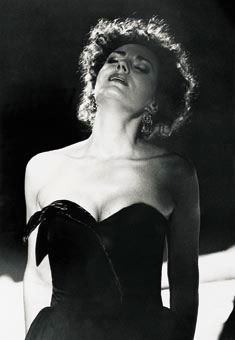


 WALTRAUD MEIER sings WAGNER


